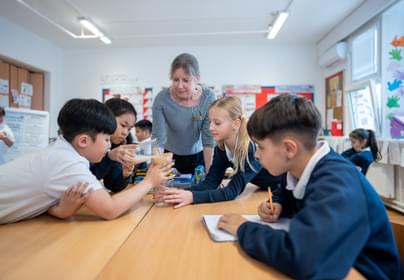
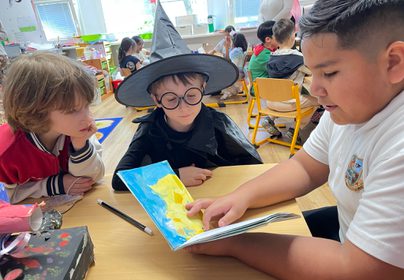
Strong foundations. Individual strengths. International opportunities.
Give your child an education that builds confidence today and creates opportunities for tomorrow.
At Britannica International School, Budapest, our British education takes students from their first years of Primary through to IGCSEs and A Levels. Combining academic ambition with a welcoming international community, we help children develop their abilities, discover their interests and prepare for their next steps.
Why choose a British education?
Choosing a curriculum means choosing how your child will learn, how their strengths will develop and which opportunities they can pursue.
The British pathway offers a compelling balance: a broad education in the earlier years, increasing subject choice as interests emerge, and focused study as university approaches.
Early confidence in reading, writing and mathematics supports learning across every subject. At Britannica, these foundations sit within a creative Primary curriculum that encourages children to explore, communicate and make connections.
Clear learning goals and regular assessment help teachers identify when a child needs additional support or greater challenge.
Children need opportunities to uncover talents they may not yet know they have.
A broad Secondary curriculum introduces students to different disciplines before they make their IGCSE choices. Science, languages, humanities and creative subjects give them room to explore their interests while developing a rounded academic foundation.
As students become clearer about their ambitions, A Levels allow them to concentrate on selected subjects and develop a deeper understanding.
For a young person with emerging strengths, this is a significant advantage: the opportunity to devote more time and attention to subjects that motivate them and support their intended university pathway. Cambridge International A Levels also develop independent learning and critical thinking skills valued by universities.
A British education can support ambitions far beyond the UK.
Cambridge International A Levels are recognised by universities worldwide, giving students a well-established route towards international higher education. Subject choices and entry requirements vary, making thoughtful planning an important part of the journey.
Year 10 parents…a great place, where children can get a superior education in a safe and stimulating international environment.
A clear pathway from Primary to university
| Stage | Typical ages | What your child develops |
|---|---|---|
| Primary School | 5-11 | Confidence in literacy and numeracy, curiosity and a broad foundation for future learning. |
| Lower Secondary School | 11-14 | Wider subject knowledge, emerging interests and increasingly independent study habits. |
| IGCSE | 14-16 | Deeper understanding through core subjects and selected options, leading to externally assessed qualifications. |
| Sixth Form | 16-18 | Focused study in three or four A Level subjects, alongside preparation for university and adult life. |
See where a Britannica education can lead
Our students’ achievements show what this pathway can make possible.
2026 examination highlights
- 49% of IGCSE grades at 9-7
- 90% of IGCSE grades at 9-4
- 37% of A Level grades at A-A*
- 62% of A Level grades at A-B*
The school’s published 2026 university destinations include Cambridge, UCL and Trinity College Dublin, alongside institutions across Europe.
Behind these results are individual students discovering what they can achieve and taking the next step towards their ambitions.
Your questions about the British curriculum
At Britannica, our programme is based on the English National Curriculum, adapted for our international community. Students progress through Primary and Secondary education towards IGCSEs and A Levels.
IGCSEs are normally taken at the end of Year 11 and cover a range of subjects. A Levels follow in Sixth Form, allowing students to study a smaller selection in greater depth as they prepare for university or other next steps.
No. Britannica provides specialist English as an Additional Language support. The level of English needed depends on the stage of entry, with strong English particularly important for A Level study. Speak to our admissions team about your child’s current language skills and requirements.
Yes. A Levels are widely recognised internationally. Each university and course sets its own requirements, including the subjects and grades needed. Britannica students have progressed to universities in the UK, elsewhere in Europe and further afield.
Discover what a British education could mean for your child
See the learning environment, meet our team and discuss how your child could progress at Britannica.
Whether you are choosing a first school or planning the next stage of education, a visit can help you picture the possibilities.
Prefer to speak to us?
Call:+36303424886
Email: admissions@britannicaschool.hu