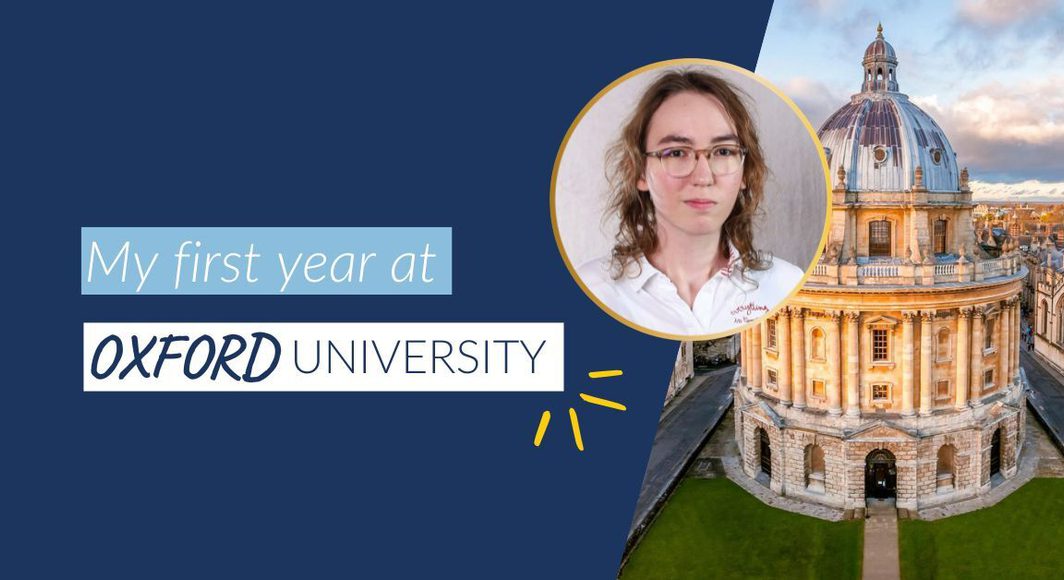
For many students, studying at University of Oxford is a dream. For one of our alumni, Viktoria, Class of 2024, that dream became a reality through dedication, perseverance and a passion for learning.

After graduating from Britannica International School, Viktoria started her academic journey at Oriel College, one of Oxford's oldest and most prestigious colleges.
In this interview, Viktoria reflects on her first year at Oxford, sharing insights to her inspiring educational experiences.
1. When did you decide that you would like to study at Oxford University?
I could call it a kind of lifelong dream – but it really started crystallising as I started high school and began learning more and more about the university's general ethos and later, that of my college, Oriel.
2. How quickly were you able to settle in?
In general, it took me most of Michaelmas (autumn-winter) term to get used to everything, but the college parent system was there to guide me through the first weeks – it’s the university’s peer support system, where freshers get assigned second-year peers who give them all sorts of guidance, ranging from academic to lifestyle topics, to help them adjust to life in Oxford. Academically, the first year was pretty fast-paced and intense, I learned something new every term, and that was equally as challenging and exciting as it sounds!
3. How does a typical day look like for you at the Campus?
It would only be a slight stretch to say that the university is the entire city: there is no designated “campus” as such, classes do not exclusively happen at one’s respective college. I, for instance, had some classes in other colleges, and even in the newly-opened research centre for Humanities. Oxford is also very much a walkable, or else a cyclable city. Outside of classes, I was mainly busy with preparing for the so-called Prelims (Preliminary Examinations, a set of exams every first year student has to take at Oxford), so I allocated much of my time for self-study, which I liked to do in my college’s library; a very cosy place with plenty of secluded spaces.
4. How does a lecture go at Oxford? Do professors teach in a traditional way?
We have a combination of regular university lectures (in a hall, with students gathering from various colleges) and the tutorial system, and Oxford is renowned for this latter aspect.
Tutorials are (generally) 2:1 classes with your tutorial partner and your tutor, where you have in-depth critical discussions about, say, books or (your own) translation excerpts on the literature/language side, papers and theories/problems on the philosophy side, and very frequently, a reading aloud and real-time analysis of your own essays. The manner of discussion can vary from discipline to discipline and from expert to expert: for example, my German tutorials tended to be more conversation-style, whilst my Philosophy ones were frequently akin to good faith debates. This, of course, is a great challenge of articulating your ideas and daring to think out loud. It also feels incredibly personal and individualised, it is genuinely the case that my tutor pays attention to my every word, I am treated with full intellectual seriousness.
5. Is there an intense workload during the year? Is there a specific examination period where you need to study really hard?
To answer the second question first, my course (and most courses as far as I know) are divided into two parts: Prelims, which is the first year, and Final Honours (FHS), which are your remaining years of study. In my case, that is three more years with one year abroad. At the end of this year, I had my Preliminary Examinations, a set of exams that do not count towards my final degree – they instead seek to test my ability to cope with the overall teaching style of the university in my chosen degree: content, pace, workload, etc. In preparation for both Prelims and FHS exams, we have termly Collections on “0th” week (the week preceding the official term start), which are essentially mock exams. Although they are only for practice, good performance can merit awards (I presume this also varies between colleges and courses). I was chosen by my college tutors to receive book grants for both my Collection performances!
To now answer the first question, Prelims preparation alone made this year quite intense for me, but I am happy to say that my work paid off in terms of scores too: I managed to achieve the equivalent of Firsts in almost all my papers, and was awarded an overall Distinction in German!
6. Are you involved in any activities within the school walls (sports, academic, pastoral)
As mentioned before, I was mainly focused on preparing for Prelims, but I plan to be more involved next year. Regardless, I tried my hand at some extracurricular activities. Most notably, I was briefly involved in student theatre on the technical side, as a sound technician trainee! Otherwise, the university offers lots of career- and skill-building opportunities, so I attended a handful of workshops and seminars pertaining to translation, teaching and theatre.
7. How is student life at Oxford? Is it only about studying or have you got opportunities for socializing?
Studying takes precedence, but yes, there are opportunities to socialise! The city of Oxford has many recreational spaces, from bookstores through theatres to cafés and parks. My college, Oriel, is also celebrating its astonishing 700th anniversary this year, which has been commemorated greatly.
On the whole, adjusting one’s work-life balance can, of course, be a challenge sometimes, but I personally take it as another learning journey. Student life at Oxford, as expressed in my previous answers, is very personalised, there is a strong focus on the individual. I also genuinely feel that my tutors are there to help and support me, they are easy to contact and have never failed to guide me. At the end of each term, there was also always a 1:1 discussion with my Oriel tutors where we could discuss progress, impressions, targets and future prospects openly.
ViktoriaClass of 2024During my A level studies I had the opportunity to delve into subjects I have developed a true passion for, and was taught by teachers who were truly dedicated to their respective subjects. This way, my experience at Britannica was a very inspirational one: it laid the foundations of my future educational and career path - wanting to become a teacher myself and inspire others the way I was inspired.


Coming Next Week: A Level Results for the Class of 2026
Viktoria’s story is a wonderful reminder of where a Britannica education can lead. Next week, we’ll be celebrating the achievements of our most recent graduates as the summer A Level results are published. We can’t wait to share their results and celebrate the hard work, dedication and determination that have brought our Class of 2026 to this exciting next chapter. Watch this space!